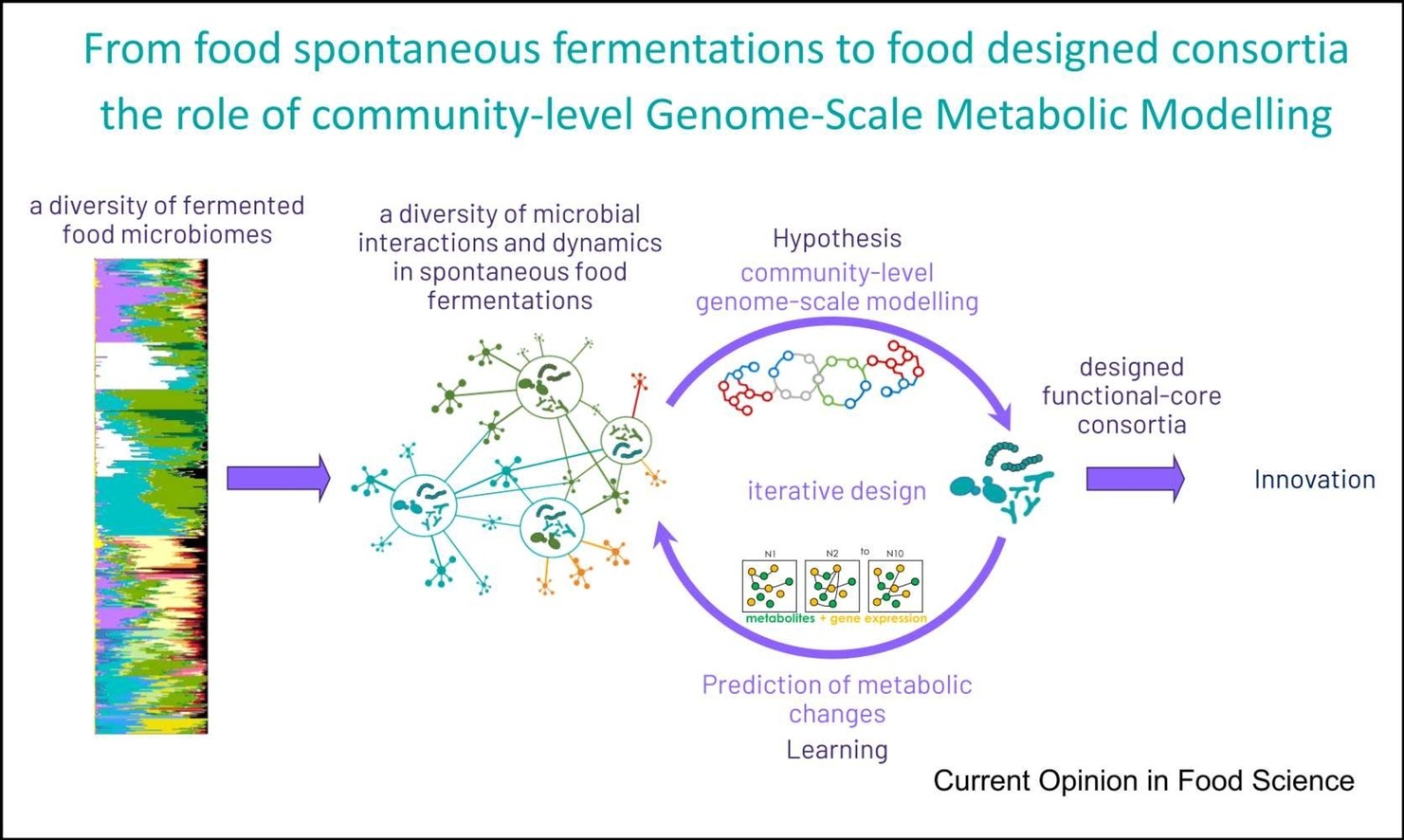
#Microbes4SustainableFoods cluster at the EFFoST conference in Valencia

Published: Nov 9, 2023 by FME Lab

Stéphane participated to the #EFFOST2023 conference in Valencia (6th to 8th of November) during which a specific session an EU project was planned.

This session was the first clustering activity of the #Microbes4SustainableFoods, a collaborative network of five European projects (#DominoEU, #HealthFerm, Pimento ca20128, #Wheatbiome and #Tribiome) with an overlapping interest in the use of microbes in the food system and in particular in plant-based fermented foods.

Stéphane gave an overview of DOMINO objectives whereas, Abelardo Margolles (WP4 leader) gave an introduction on our strategy to design microbial consortia based on synthetic ecology approaches. The session was concluded by a roundtable discussion with the audience.

Off the conference, all coordinators met for a friendly dinner which was also the kick-off for organizing and sharing communications, disseminations and results over the coming years between the different projects.
Share

Latest Posts

The FME lab communicates about the links between the microbiome, nutrition and health.

On Thursday 27 November, the FME lab took part in the Food System Microbiomes Conference in Wageningen during the session dedicated to the connections between microbiomes, nutrition and health. The session was co-chaired by Stéphane Chaillou (INRAE, Micalis) and Prof. Christophe Courtin (KU Leuven), and provided an opportunity to showcase advances from two major European projects: DOMINO and HealthFerm.

Understanding How Fermented Foods Shape Health Insights From a New PIMENTO Review

A new scoping review published in Frontiers in Nutrition1 as part of the COST Action PIMENTO initiative provides a comprehensive assessment of what is currently known about the health effects of fermented foods in specific human populations. This work reflects a substantial collective effort. We conducted an extensive and rigorous screening of the scientific literature, reviewing and selecting studies across many categories of fermented foods and health outcomes.

  1. Humblot Christèle, Alvanoudi Panagiota, Alves Emilia, Assunçao Ricardo, Belovic Miona, Bulmus-Tuccar Tugce, Chassard Christophe, Derrien Muriel, Karagöz Mustafa Fevzi, Karakaya Sibel, Laranjo Marta, Mantzouridou Fani Th, Rosado Catarina, Pracer Smilja, Saar Helen, Tap Julien, Treven Primož, Vergères Guy, Pertziger Eugenia, Savary-Auzeloux Isabelle, A scoping review of the health effects of fermented foods in specific human populations and their potential role in precision nutrition: current knowledge and gaps. Frontiers in Nutrition. 2025 doi:10.3389/fnut.2025.1650633 

New tool suite - Food Microbiome Metabolic Modules (F3M)

The FME team has published a new preprint in Open Research Europe entitled
“Food Microbiome Metabolic Modules (F3M): a tool suite for functional profiling of food microbiomes.”
Read the article