Teaching Kids about the Microbial World: Merci les bactéries !

Published: Apr 2, 2024 by FME Lab

In a unique venture at a primary school in the southern suburbs of the Paris region, the Food Microbial Ecology Team and the PhylHom team united to teach microbiology, fermented foods, and the gut microbiome to curious young minds. In a vibrant classroom, 50 kids engaged in a dynamic 30-minute session, exploring the microscopic world through interactive discussions and vivid illustrations.

Post-discussion, a quiz tested their knowledge, followed by a hands-on Petri Dish Handwashing Experiment, vividly demonstrating microbes’ role in our hygiene practices. Children pressed their hands onto agar plates before and after washing them, setting the stage for a revealing observation of microbial growth.
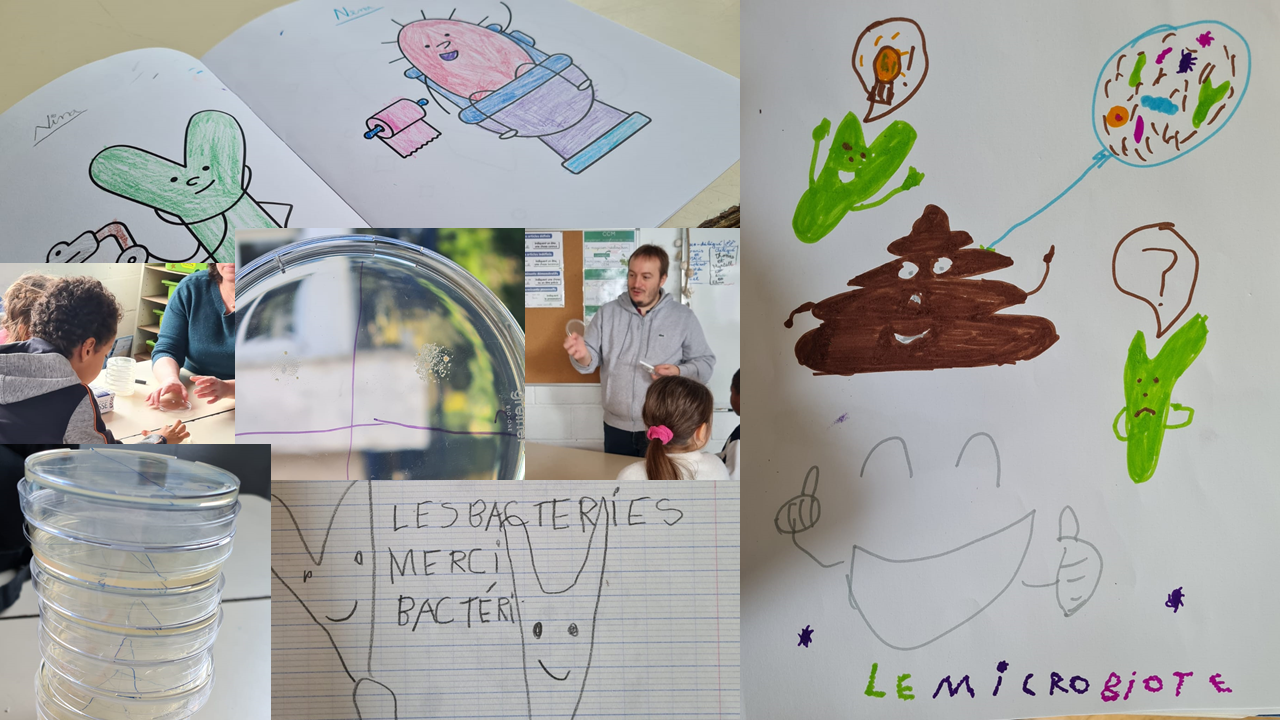
The session culminated in creative expression, with children illustrating and writing about their learnings. One touching note read, “Merci les bactéries !”—a testament to the impactful and engaging nature of this educational journey at the primary school.

Special thank to Anne-Sophie French Gut team and Vlad from Micalis MIMA2 for sharing coloring books and miscroscopic photos.
Share

Latest Posts

From “synthetic” to defined microbial communities for clearer terminology

Stéphane Chaillou participated in a joint reflection with a group of international researchers, coordinated by the Austrian Institute of Technology (AIT), on the terminology used to describe certain microbial communities. The collective of experts proposes replacing the term “synthetic community” (or SynCom), sometimes perceived negatively, with “Defined Microbial Community”.

Harnessing gut microbiome diversity for next-generation fermented foods

On June 5, 2026, Julien Tap participated in the INRAE-Tokyo NODAI Joint Symposium on Fermentation and Food Bioscience. This online event brought together researchers from INRAE and the Tokyo University of Agriculture to discuss fermentation microbiology, food bioscience, taste, and microbiome-based approaches to health. More than 100 participants attended the symposium, most of them Japanese students, highlighting the strong interest of the next generation in fermentation and microbiome science.

DOMINO 3rd annual meeting in Madrid

After three years, the #DominoEU project has reached full speed, with significant results across all project objectives. The three-day meeting provided an opportunity to review the very busy year of 2025 and the many key findings that can be leveraged in the coming months.