Understanding How Fermented Foods Shape Health Insights From a New PIMENTO Review

Published: Nov 13, 2025 by FME Lab

A new scoping review published in Frontiers in Nutrition1 as part of the COST Action PIMENTO initiative provides a comprehensive assessment of what is currently known about the health effects of fermented foods in specific human populations. This work reflects a substantial collective effort. We conducted an extensive and rigorous screening of the scientific literature, reviewing and selecting studies across many categories of fermented foods and health outcomes.

A central message emerges clearly: people do not respond to fermented foods in the same way. Individual variability is striking, and the gut microbiome may plays a key role in shaping these differences. The authors emphasize that baseline microbiome composition and function may influence how individuals metabolize and benefit from fermented foods. Despite this growing evidence, mechanistic studies remain scarce, and the field still lacks precision-nutrition frameworks needed to predict who will benefit most.
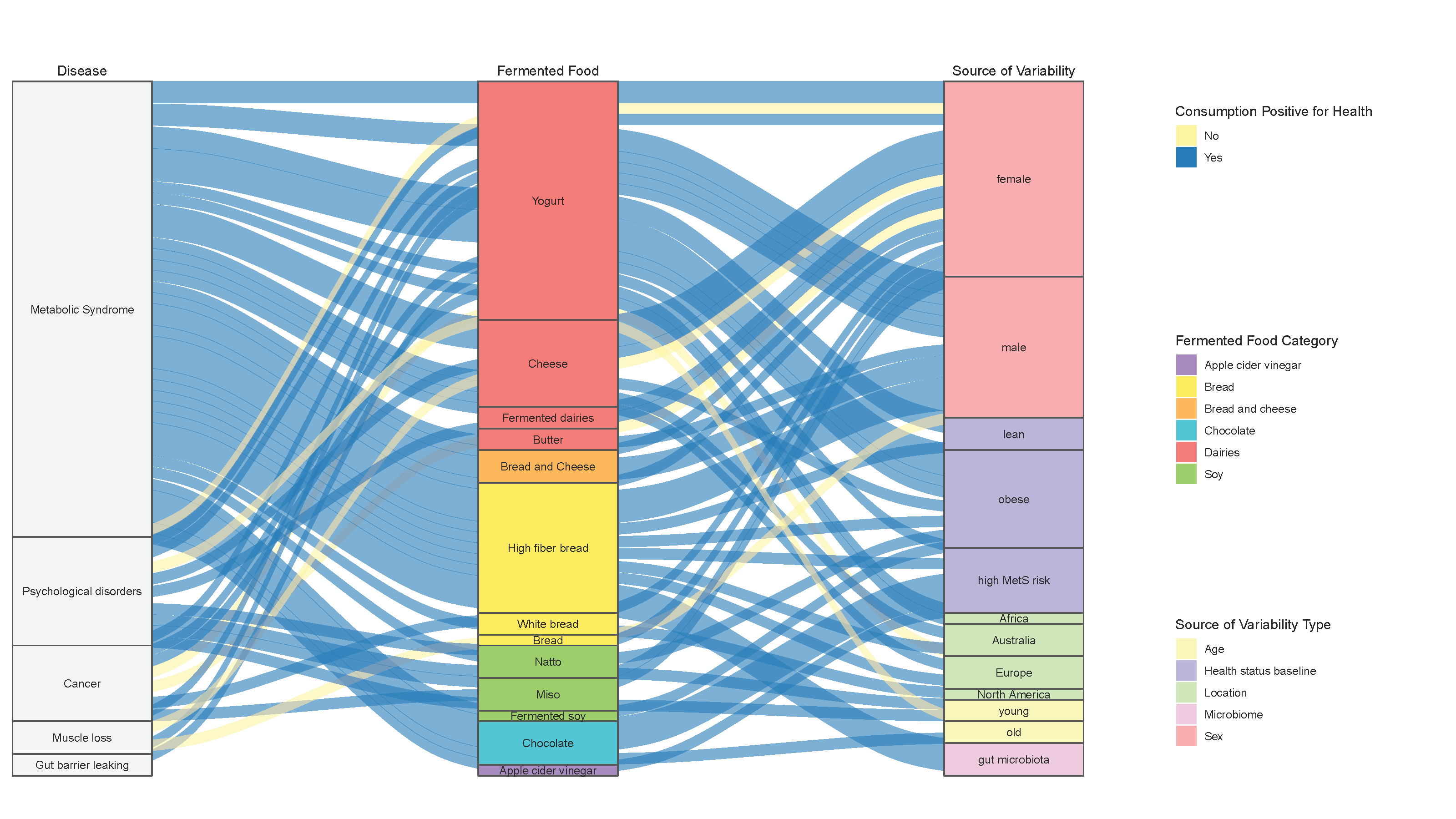
Summary of interactions between health outcomes, fermented foods, and variability sources.
Sankey diagram illustrating the relationship between health outcomes (ex: metabolic syndrome, cancer), fermented food categories (ex: yogurt and cheese), and variability source (ex: age, sex). The color-coded flows indicate whether consumption is positive for health, categorized as yes (blue) or no (yellow).

The review also identifies major gaps: limited standardization of study designs, inconsistent reporting, and insufficient stratification between responders and non-responders. Addressing these limitations will be essential to move from broad dietary recommendations toward targeted, personalized strategies involving fermented foods.

As interest in microbiome-driven nutrition continues to rise, this work provides timely guidance for researchers and practitioners aiming to connect fermented food consumption with measurable, individualized health outcomes.

  1. Humblot Christèle, Alvanoudi Panagiota, Alves Emilia, Assunçao Ricardo, Belovic Miona, Bulmus-Tuccar Tugce, Chassard Christophe, Derrien Muriel, Karagöz Mustafa Fevzi, Karakaya Sibel, Laranjo Marta, Mantzouridou Fani Th, Rosado Catarina, Pracer Smilja, Saar Helen, Tap Julien, Treven Primož, Vergères Guy, Pertziger Eugenia, Savary-Auzeloux Isabelle, A scoping review of the health effects of fermented foods in specific human populations and their potential role in precision nutrition: current knowledge and gaps. Frontiers in Nutrition. 2025 doi:10.3389/fnut.2025.1650633 

Share

Latest Posts

The FME lab communicates about the links between the microbiome, nutrition and health.

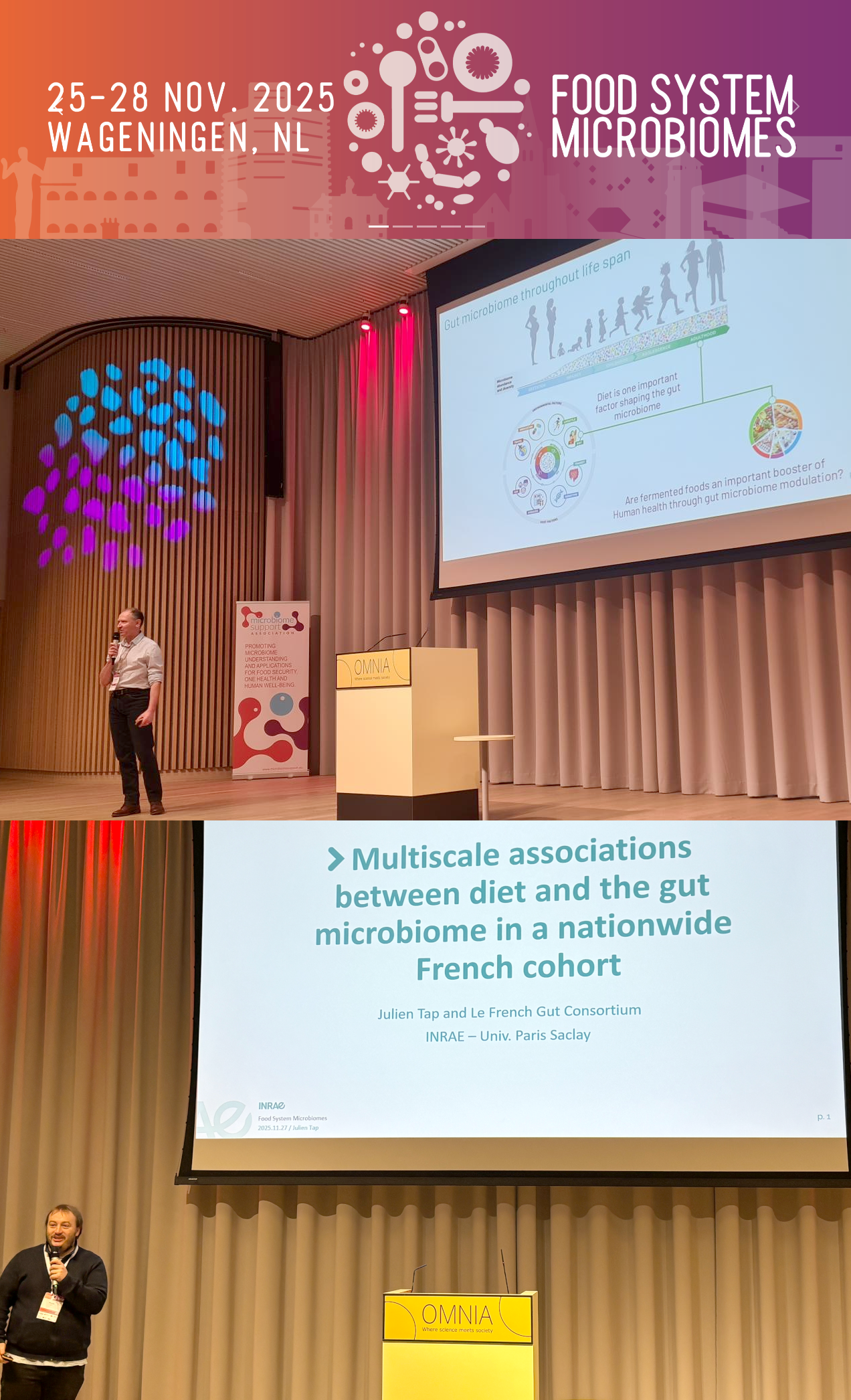
On Thursday 27 November, the FME lab took part in the Food System Microbiomes Conference in Wageningen during the session dedicated to the connections between microbiomes, nutrition and health. The session was co-chaired by Stéphane Chaillou (INRAE, Micalis) and Prof. Christophe Courtin (KU Leuven), and provided an opportunity to showcase advances from two major European projects: DOMINO and HealthFerm.

Understanding How Fermented Foods Shape Health Insights From a New PIMENTO Review

A new scoping review published in Frontiers in Nutrition1 as part of the COST Action PIMENTO initiative provides a comprehensive assessment of what is currently known about the health effects of fermented foods in specific human populations. This work reflects a substantial collective effort. We conducted an extensive and rigorous screening of the scientific literature, reviewing and selecting studies across many categories of fermented foods and health outcomes.

  1. Humblot Christèle, Alvanoudi Panagiota, Alves Emilia, Assunçao Ricardo, Belovic Miona, Bulmus-Tuccar Tugce, Chassard Christophe, Derrien Muriel, Karagöz Mustafa Fevzi, Karakaya Sibel, Laranjo Marta, Mantzouridou Fani Th, Rosado Catarina, Pracer Smilja, Saar Helen, Tap Julien, Treven Primož, Vergères Guy, Pertziger Eugenia, Savary-Auzeloux Isabelle, A scoping review of the health effects of fermented foods in specific human populations and their potential role in precision nutrition: current knowledge and gaps. Frontiers in Nutrition. 2025 doi:10.3389/fnut.2025.1650633 

New tool suite - Food Microbiome Metabolic Modules (F3M)

The FME team has published a new preprint in Open Research Europe entitled
“Food Microbiome Metabolic Modules (F3M): a tool suite for functional profiling of food microbiomes.”
Read the article