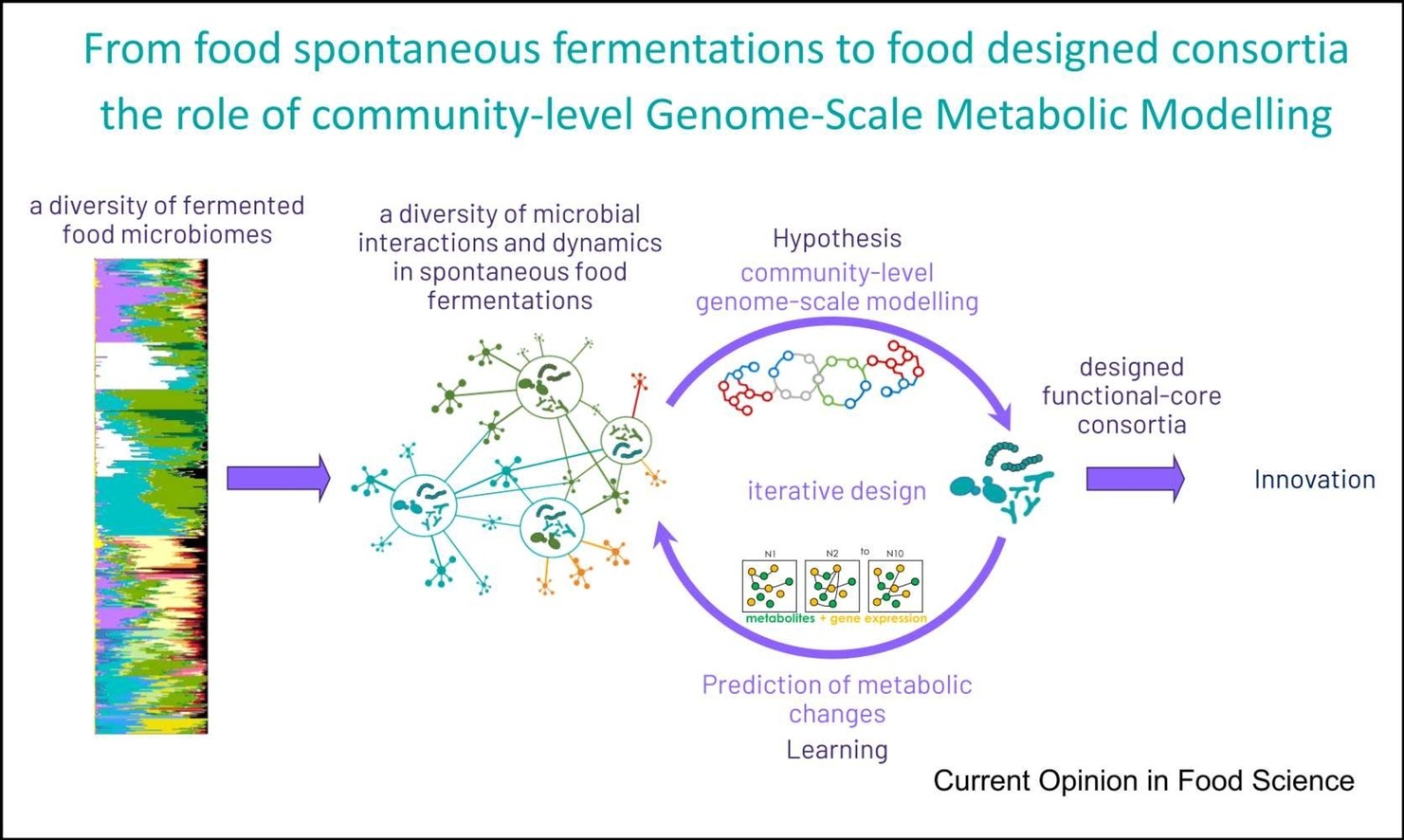
Webinar on genome-scale modelling for consortia design

Published: May 28, 2024 by FME Lab

Last Tuesday 28th of May, Elham Karimi, Stephane Chaillou (Micalis, Food Microbial Ecology research group) and Valentin Loux (MaIAge) have organised in the frame of the #DominoEU project a webinar training session on genome-scale modelling (GSM).

This training aimed at performing the first cross-capacity building between two workpackages (WP3: Open access databases & computational tools) and (WP4: design of microbial consortia for sustainable plant-based fermented foods) and towards scientists from various background. GSM will be used in #DominoEU project for the design of microbial solution for various plant-based fermented food. Metagenomic and genomic data from samples and strains isolated at the beginning of the project will be used as template for this very challenging but exciting modelling. Next steps will be the GSM workshop 24-26th of June in INRAE Jouy-en-Josas.

Special thanks to the participants: Pascal Bonnarme, Vincent Hervé, Ayité Adama, Sophie Schbath (INRAE) ; Ilaria Ferrocino, Kelly Rantsiou (UNITO) ; Abelardo Margolles, Pedro Riesco, Lorena Ruiz (CSIC) ; Bastien Renard, Christèle Humblot (IRD) ; John Kenny, Katie O’Mahony, Anik Khan (TEAGASC) ; Jekaterina Kazantseva (TFAK) ; Claudia Mengoni, Hriturak Dey (UNITN) ; Tanja Kostic (AIT).
Share

Latest Posts

The FME lab communicates about the links between the microbiome, nutrition and health.

On Thursday 27 November, the FME lab took part in the Food System Microbiomes Conference in Wageningen during the session dedicated to the connections between microbiomes, nutrition and health. The session was co-chaired by Stéphane Chaillou (INRAE, Micalis) and Prof. Christophe Courtin (KU Leuven), and provided an opportunity to showcase advances from two major European projects: DOMINO and HealthFerm.

Understanding How Fermented Foods Shape Health Insights From a New PIMENTO Review

A new scoping review published in Frontiers in Nutrition1 as part of the COST Action PIMENTO initiative provides a comprehensive assessment of what is currently known about the health effects of fermented foods in specific human populations. This work reflects a substantial collective effort. We conducted an extensive and rigorous screening of the scientific literature, reviewing and selecting studies across many categories of fermented foods and health outcomes.

  1. Humblot Christèle, Alvanoudi Panagiota, Alves Emilia, Assunçao Ricardo, Belovic Miona, Bulmus-Tuccar Tugce, Chassard Christophe, Derrien Muriel, Karagöz Mustafa Fevzi, Karakaya Sibel, Laranjo Marta, Mantzouridou Fani Th, Rosado Catarina, Pracer Smilja, Saar Helen, Tap Julien, Treven Primož, Vergères Guy, Pertziger Eugenia, Savary-Auzeloux Isabelle, A scoping review of the health effects of fermented foods in specific human populations and their potential role in precision nutrition: current knowledge and gaps. Frontiers in Nutrition. 2025 doi:10.3389/fnut.2025.1650633 

New tool suite - Food Microbiome Metabolic Modules (F3M)

The FME team has published a new preprint in Open Research Europe entitled
“Food Microbiome Metabolic Modules (F3M): a tool suite for functional profiling of food microbiomes.”
Read the article