Published: Apr 14, 2026 by FME Lab
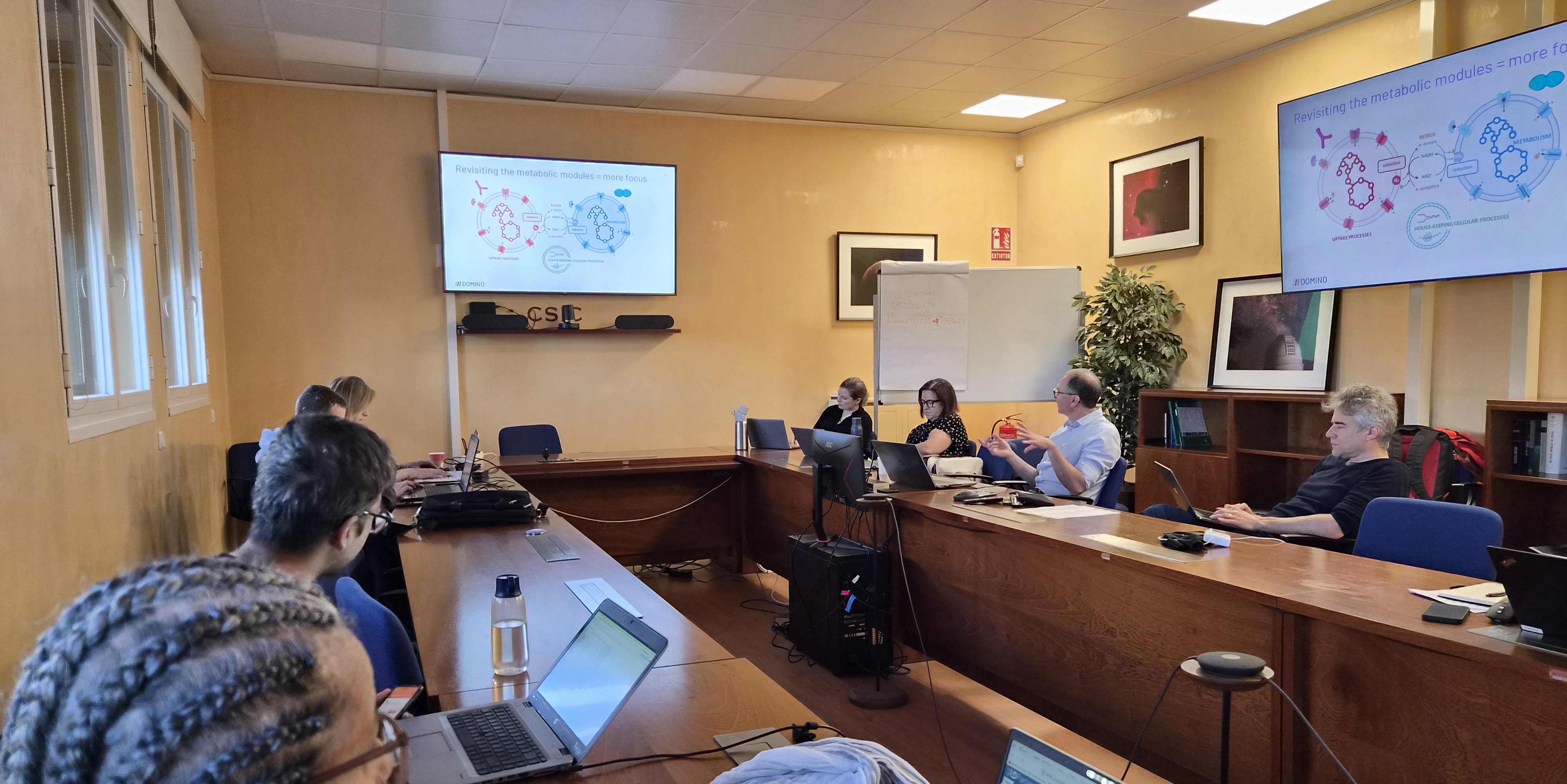
The 14th of April 2026, teams from INRAE (MICALIS & MaIAGE) organised a hands-on workshop in Madrid at CSIC, focused on the F3M ecosystem (Food Microbiomes Metabolic Modules) and its associated tools for functional microbiome analysis.
This workshop was organised in the framework of the Domino project, with a strong focus on enabling partners to manipulate the F3M tool suite for microbiome data integration, gene catalog construction, and functional interpretation.
The morning sessions introduced the conceptual foundations of the F3M curated database and the associated tools.
Participants were then guided through practical use of the f3mr R package, focusing on data aggregation at both taxonomic and functional levels, normalization, and differential analysis workflows (notably using DESeq2), followed by integration into phyloseq for downstream functional mining.
See the tutorial here
After a working lunch, the afternoon sessions shifted toward more advanced tasks. Participants explored how to map metagenomic reads onto an existing F3M-inferred gene catalog, and how to construct a custom gene catalog from a defined list of microbial species. The tutorial, developed by Mohellibi Nacer, Stéphane Chaillou, and Valentin Loux, provided a complete pipeline:
- Mapping reads to a reference gene catalog using f3m_builder map
- Building gene catalogs from pangenomic inputs using f3m_builder build_catalog
- Exploring outputs in R using f3mr
The training relied on the Migale HPC infrastructure, with both interactive (qlogin) and batch (qsub) execution modes, ensuring scalability and reproducibility of analyses.
A key outcome of the workshop is that participants are now able to move across the full workflow: from raw sequencing reads to structured functional profiles linked to metabolic modules. This enables a tighter integration between microbial composition and functional potential in food microbiome datasets. The session ended with discussions on applications, including the design of microbial consortia and the exploitation of F3M modules for hypothesis-driven microbiome engineering.
Thank to CSIC for hosting.